
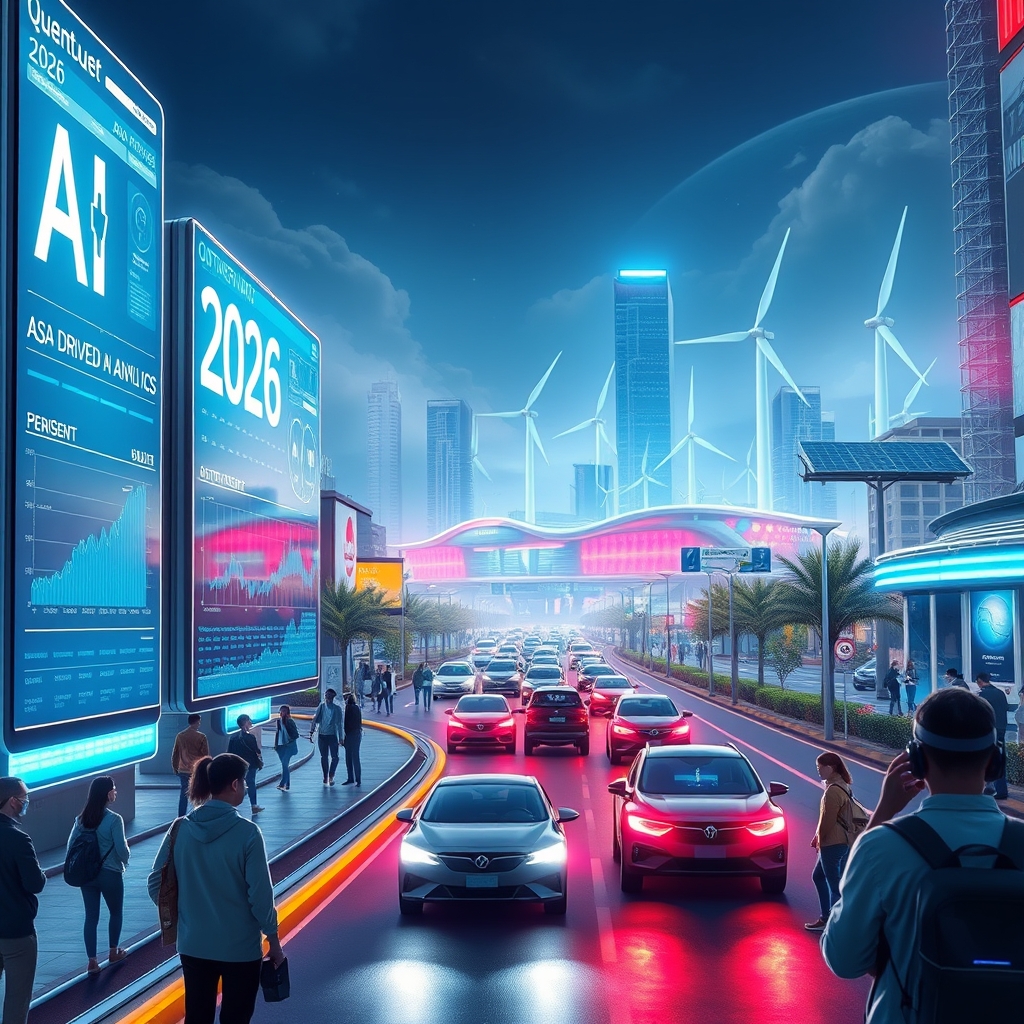
Technology in 2026 is set to redefine how we live, work, and interact with the world. From groundbreaking advancements in artificial intelligence to revolutionary shifts in sustainability and connectivity, the next two years promise transformative changes. Businesses, consumers, and innovators must stay ahead of these trends to leverage opportunities and navigate challenges. This article explores the most impactful technology trends shaping 2026, offering insights into what’s next for industries and everyday life.
What Are the Most Disruptive Technology Trends in 2026?
By 2026, several emerging technologies will dominate headlines and disrupt traditional industries. Artificial intelligence (AI) will evolve beyond automation, becoming deeply integrated into decision-making processes. Quantum computing, though still in its infancy, will make significant strides, potentially solving complex problems in seconds. Meanwhile, the metaverse will expand beyond gaming, creating immersive digital workplaces and social spaces.
Furthermore, edge computing will gain traction as businesses seek faster, more secure data processing. The Internet of Things (IoT) will continue to grow, with an estimated 30 billion connected devices worldwide by 2026. These trends will not only enhance efficiency but also raise critical questions about privacy, security, and ethical use. Staying informed about these developments is essential for anyone looking to thrive in the digital age.
How Will AI and Machine Learning Evolve by 2026?
AI and machine learning will undergo a paradigm shift by 2026, moving from narrow applications to generalized intelligence. Expect AI to handle more nuanced tasks, such as real-time language translation with near-human accuracy. Businesses will rely on AI-driven analytics to predict market trends, reducing decision-making time by up to 40%. Additionally, AI will play a pivotal role in healthcare, enabling personalized treatment plans based on genetic data.
However, this rapid evolution will also bring challenges. Ethical concerns around AI bias and job displacement will intensify, prompting governments to introduce stricter regulations. Companies investing in AI will need to prioritize transparency and accountability to maintain public trust. The balance between innovation and responsibility will define AI’s trajectory in the coming years.
Is the Metaverse Ready for Mainstream Adoption?
The metaverse will transition from a niche concept to a mainstream platform by 2026. Virtual reality (VR) and augmented reality (AR) technologies will merge, creating seamless digital experiences. Businesses will leverage the metaverse for remote collaboration, virtual events, and even digital storefronts. By 2026, the global metaverse market could exceed $800 billion, driven by demand for immersive entertainment and workspaces.
Yet, adoption won’t be without hurdles. High costs of VR/AR hardware and concerns about digital privacy may slow progress. Companies will need to address these barriers by offering affordable solutions and robust security measures. As the metaverse matures, it will redefine social interactions, commerce, and education, making it one of the most exciting trends to watch.
What Role Will Quantum Computing Play in 2026?
Quantum computing will move closer to practical applications by 2026, though widespread commercial use remains years away. Early adopters in finance, pharmaceuticals, and logistics will use quantum systems to optimize complex processes. For example, drug discovery could accelerate by 50% as quantum computers simulate molecular interactions with unprecedented precision. Governments and corporations will invest heavily in quantum research, with global spending expected to surpass $16 billion by 2026.
Despite its potential, quantum computing faces significant challenges. Error rates and stability issues must be resolved before it can outperform classical computers. Collaboration between academia and industry will be crucial to overcoming these obstacles. As quantum computing matures, it will unlock solutions to problems once deemed unsolvable, from climate modeling to cryptography.
How Will Sustainability Drive Technology Innovation?
Sustainability will be a core driver of technology innovation in 2026. Green tech solutions, such as carbon capture and renewable energy storage, will gain momentum as climate goals tighten. Companies will prioritize circular economy models, reducing waste and maximizing resource efficiency. By 2026, the global green technology market could reach $44.61 billion, reflecting growing demand for eco-friendly solutions.
In addition, AI will play a key role in sustainability efforts. Smart grids will optimize energy distribution, while IoT sensors will monitor environmental impact in real time. Consumers will also demand transparency, pushing brands to adopt sustainable practices. Technology will not only enable greener operations but also create new business opportunities in the fight against climate change.
What Are the Cybersecurity Challenges in 2026?
Cybersecurity will face unprecedented challenges in 2026 as cyber threats grow in sophistication. Ransomware attacks will become more targeted, with global damages projected to exceed $265 billion annually. The rise of quantum computing will also threaten current encryption methods, forcing businesses to adopt post-quantum cryptography. Governments will implement stricter cybersecurity regulations, holding companies accountable for data breaches.
To stay ahead, organizations will invest in AI-driven security tools that detect and respond to threats in real time. Employee training and zero-trust architecture will become standard practices. As technology advances, so too will the tactics of cybercriminals, making cybersecurity a top priority for businesses and individuals alike.
FAQ: Your Top Questions About Technology Trends in 2026
Will AI Replace Human Jobs by 2026?
AI will automate repetitive tasks, but it won’t replace human jobs entirely. Instead, it will create new roles in AI management, ethics, and creative fields. By 2026, AI could augment 60% of existing jobs, enhancing productivity rather than eliminating positions. Upskilling and adaptability will be key to staying relevant in the evolving job market.
How Will 6G Impact Connectivity in 2026?
6G technology will begin testing in 2026, promising speeds up to 100 times faster than 5G. It will enable near-instantaneous data transfer, supporting advancements in autonomous vehicles and smart cities. However, widespread adoption won’t occur until the early 2030s. Early 6G networks will focus on industrial and research applications, paving the way for a hyper-connected future.
What Are the Ethical Concerns Around AI in 2026?
Ethical concerns will center on AI bias, privacy, and accountability. Governments will introduce regulations to ensure fairness in AI decision-making. Companies will need to implement ethical AI frameworks to avoid reputational damage. Transparency in AI algorithms will become a competitive advantage, as consumers demand responsible technology use.
Preparing for the Future: Key Takeaways
Technology trends in 2026 will shape industries, economies, and daily life in profound ways. From AI and quantum computing to the metaverse and sustainability, innovation will drive progress at an unprecedented pace. Businesses and individuals must adapt to these changes, embracing new opportunities while addressing ethical and security challenges.
Staying informed about trends in technology news for 2026 is not just about keeping up—it’s about leading the way. By understanding these developments, you can position yourself at the forefront of the digital revolution, ready to thrive in a rapidly evolving world.
About the Author


